I've strung, weighted, and rebuilt more setups than I can count — and the one thing I keep coming back to is lead tape. It costs a few dollars, takes ten minutes, and changes how your racket feels more than a string job half the time. Most players ignore it. That's a mistake.
I did a full walkthrough of my current setup on YouTube if you'd rather watch first:
And if you want to see how I built out my Blade V9 for a tournament — including the exact lead tape I used — that breakdown is here too:
What does lead tape actually do?
Lead tape adds static weight to your frame, and where you put it decides what you feel. It's not magic. It moves your swing weight, balance point, and stability in ways you can measure — and if you add it in the wrong spot, you'll feel that too.
Three things change when you add tape:
Swing weight — how hard the racket is to swing. Mass placed far from your hand (the hoop tip) raises this fast. Mass in the handle barely moves it.
Plow-through — how much the frame holds pace through contact. More swing weight = more plow. Serves that land short and groundstrokes that die in the net are often a swing weight problem, not a technique problem.
Stability — how much the frame twists on off-center hits. Weight at 3 and 9 o'clock raises this without much swing weight penalty. If you're shanking a lot, try here before you try anywhere else.
Lead tape will not fix your technique, your timing, or a string setup that's already wrong. Test with numbers across a block of matches, not gut feel after one hitting session.
Where to put it
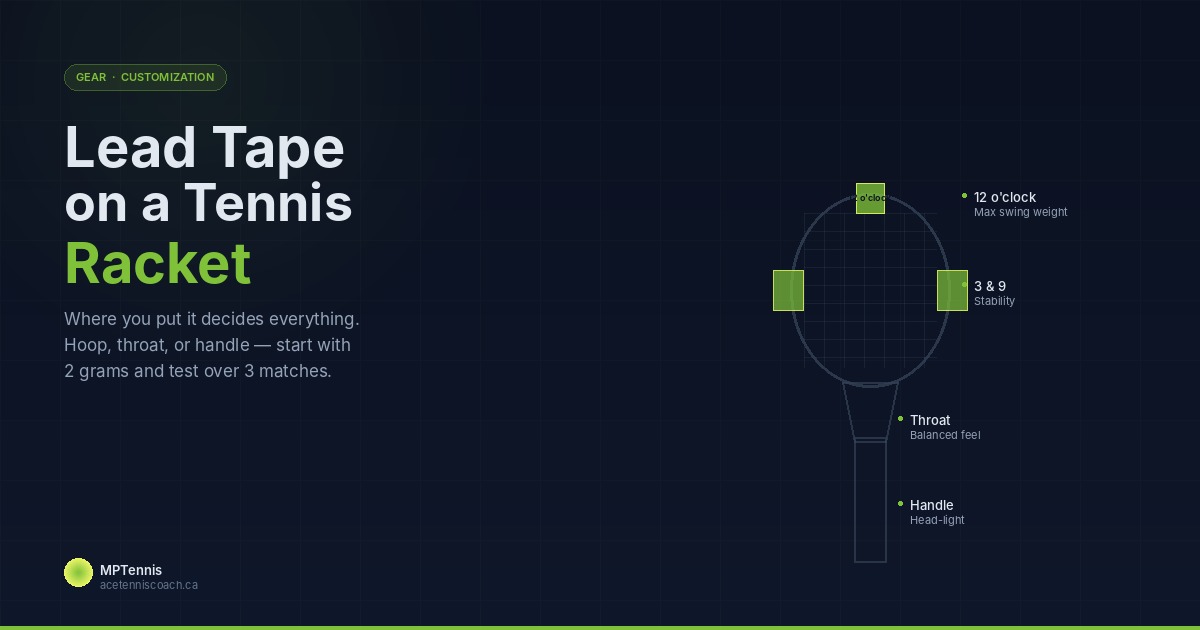
The same 2 grams in three different spots produces three different rackets. Pick your problem first, then pick the spot.
| Placement | Effect | Use it when |
|---|---|---|
| 12 o'clock | Maximum swing weight, most plow-through | Serves land short, groundstrokes die |
| 3 and 9 o'clock | Higher stability, less frame twist | Off-center hits are costing you |
| Throat | Moderate swing weight, keeps hoop lively | You want more depth without killing touch |
| Handle (under grip) | Balance shift only, no swing weight change | Making a head-heavy frame feel quicker |
12 o'clock sits farthest from your hand, so each gram counts roughly three times more than at 3 and 9. Start here if your problem is pace and depth.
3 and 9 spread weight across the hoop width. This raises twist weight more than swing weight, which is why it helps with shanks and spin from heavy hitters.
Throat is the middle path. More swing weight than the handle, less drag than the tip, and a slightly higher balance point without turning the racket head-heavy. I used throat placement on my Head Extreme Pro build and it changed how the frame felt at net:
Handle weight doesn't change swing weight at all. It just makes the frame more head-light. Useful if your current setup feels sluggish through contact but you don't want to sacrifice the hoop weight you've already built.
How much to add
Start at 2 grams. That's one 4-inch strip of half-inch tape at roughly 0.5g per inch. Place it at 12 o'clock. Hit 20 serves and 20 groundstrokes.
If nothing changes, go to 4 grams. If 4 grams feels right but you want more, go to 6.
Don't jump straight to 6. That's how you end up with a serve toss you can't trust and a racket that feels completely foreign. Give each dose three hitting sessions before you add more.
Remove the tape if:
- First-serve percentage drops across three matches
- You're consistently late on returns
- Off-pace shots start flying long
That's usually a sign the added swing weight outpaced your timing. Peel it back to the last dose that worked, or shift half the weight toward the throat.
I tracked the exact setup I landed on after three months with the Radical Pro here:
Lead vs tungsten
Both do the same job. Tungsten is denser, so you get more weight per inch of tape, which matters if you're adding mass at 12 and don't want tape sticking past the bumper guard. Lead is cheaper and easier to cut.
The real difference: lead is toxic to handle. Wash your hands after cutting it. Keep scraps away from kids. Tungsten skips that issue entirely.
If you're experimenting across multiple setups and expect to peel and re-stick a lot, lead tape is fine. If you have juniors in your bag or you want cleaner placement with smaller strips, spend the extra few dollars on tungsten.
Both are legal under ITF rules. No restrictions.
What width to buy
Half-inch is the standard. It bends cleanly around the hoop and sits flat in the throat without lifting at the edges. This is what you want for 90% of placements.
Quarter-inch suits the handle, where you're stacking tape under a replacement grip or along the bevels. Easier to keep tidy.
Three-quarter-inch or wider is for players who want meaningful mass in fewer strips. Useful at 12 if you're adding 6+ grams and don't want a stack of small strips.
Pre-cut strips (usually 2 or 5 grams each) remove the guesswork. You know exactly what you added and can replicate it on a second frame. Rolls cost less per gram and let you fine-tune in smaller increments, but you need a kitchen scale and sharp scissors to keep measurements honest.
How to apply it without damaging the frame
- Clean the surface with isopropyl alcohol
- Cut the tape with scissors — don't tear it
- Peel the backing slowly so adhesive stays on the tape, not your fingers
- Press from the center outward, working out air bubbles with your thumb
To remove: warm the tape with a hairdryer for 20 to 30 seconds before peeling. The adhesive releases cleanly without lifting paint. If residue stays behind, a little rubbing alcohol on a microfibre cloth takes it off. Never scrape with metal.
To add tape under the bumper guard at 12 o'clock: loosen the guard slightly with a thin spatula or stringing awl, thread the tape through, then reseat the guard. Keep strips 2 to 4 inches long so the edges don't catch on your bag.
How to know if it worked
Feel lies. A heavier hoop can make contact sound cleaner while your first-serve percentage quietly drops. Test with numbers.
Play at least three matches with the taped setup. Track first serves in, second-serve points won, and unforced errors off both wings. Compare that block against your last three matches with the stock frame. One match is weather. Three is a trend.
If you're logging matches in Ace Tennis Coach, your stat blocks are already there. Pull the comparison after the third match and let the numbers make the call.
FAQ
Does lead tape really make a difference?
Yes, if you add enough of it in the right spot. Most players feel 5 to 10 grams in the hoop because mass far from your hand raises swing weight fast. The same weight in the handle is barely noticeable. Test it over several matches before trusting the feel.
How much does 1 inch of lead tape weigh?
A 1-inch strip of standard half-inch lead tape weighs roughly 0.5 grams. That's why 2 grams equals one 4-inch strip. Tungsten tape is denser, so the same length weighs more. Use a kitchen scale if you're being precise.
Is lead tape legal in tennis?
Yes. The ITF Rules of Tennis permit weights attached to the frame, and neither lead nor tungsten is restricted. You can use either in sanctioned play. The only real constraint is handling: wash your hands after cutting lead strips and keep scraps away from kids.
Can lead tape cause tennis elbow?
Not directly, but added swing weight can contribute to arm strain if it outpaces your timing. If late-swing errors creep in or your serve percentage drops across a three-match block, the added weight is probably too much. Remove a strip, retest, or shift weight toward the throat.
Where do I start if I've never used lead tape?
Two grams at 12 o'clock. One 4-inch strip of half-inch tape. Hit 20 serves, 20 groundstrokes. That's the dose. Don't skip steps.